Design Decisions
Authava Design Decisions
These are some of the design decisions we've made for Authava. They are not declarations that one approach is objectively better. They reflect our philosophy and how we think about building something that serves real businesses.
Using "Bot" Instead of "Agent"
The technically accurate term is "agent." In AI, that usually means a system that can pursue goals, use tools or APIs, and take multi-step actions, often autonomously or with minimal guidance.
The industry has leaned into the term heavily. You'll hear exaggerated phrases like "multi-agentic distributed cognitive agents" with enough adjectives to obscure what anything actually does. And often, the more buzzwords, the bigger the bill.
We use "bot."
Every business owner we work with knows exactly what a bot is: something their customers can talk to in natural language that makes their life easier. We are engineers who appreciate technical precision, but our primary focus is helping businesses deliver value to the people they serve. Clarity wins over accuracy when the two are in conflict.
So whether it's a phone bot, a chat bot, or just a bot — that's what we call it.
Not Requiring a Name to Proceed
Every business owner wants to know who is visiting their site. Name, email, phone number. The question is how you ask.
There are two common approaches:
(A) The bot politely asks as part of the natural conversation.
(B) The bot requires contact information before the visitor can proceed — sometimes enforced with a blocking form.
We favor option A.
Authava bots ask politely and conversationally. That means visitors will sometimes ignore the question. That is okay.
Some prefer option B. The argument is that it improves conversion rates, looks clean in a demo, and produces measurable KPIs. We understand the appeal.
We disagree for five reasons:
Privacy. If someone wants to share their contact information, they will. Demanding it feels invasive before the relationship has started.
Drop-off. Visitors who hit a forced form either leave silently or enter fake information. A bot that won't answer an easy question like "what are your office hours?" without first requiring your name loses the prospect.
Data quality. Forced forms inflate lead counts but degrade quality. Visitors enter fake information, which pollutes the real leads who chose to share their details.
Our users really dislike it. We work closely with our partners and hear this consistently, and frankly, we'd dislike it ourselves. Forcing someone to hand over their contact details before getting a simple answer does more damage to the brand than the extra leads are worth.
Misleading pretense. Bots often ask for contact information under a misleading justification, such as "so we can follow up" or "to serve you better." Visitors see through it, and it hurts the brand.
Give value to the visitor first. If a visitor wanted to share their information, they would.
If a visitor cannot ask the most basic question without providing their full contact details first, you might as well lock your entire website behind a contact form.
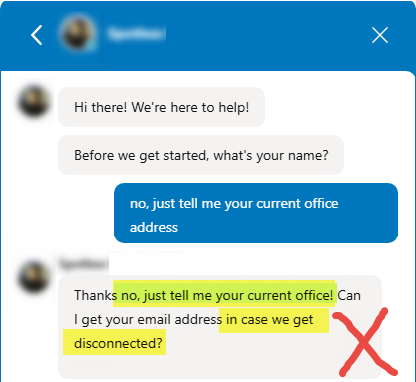
Real sample (made anonymous): It asks for your name before helping — justified as “in case we get disconnected.”